What Actually Drives AI Visibility in 2026 - According to People Who Are Actually Testing It
Key Findings
AI citations are driven primarily by consistent, credible visibility across third-party sources—not by publishing content only on a clinic’s website.
Reddit remains influential for recommendations and patient-experience questions, but its citation share is volatile; physicians need authority across multiple platforms.
Specific, experience-based, entity-rich answers are more useful to AI than vague promotional claims or generic medical content.
The main answer should appear early, and each section should be clear enough to stand alone when extracted from the page.
Fake community engagement, keyword stuffing disguised as GEO, and short-term citation campaigns do not create durable authority.
AI visibility requires ongoing multi-platform measurement tied to consultations and patients—not simply citations or website traffic.
Let's be honest. Most of the GEO and AEO advice floating around right now is just SEO repackaged with a new acronym. The buzzwords are new. The actual thinking, not so much.
But underneath the noise, there is a real and meaningful shift happening. And if you're running a brand, a startup, or a content operation, you're either adapting to it or slowly becoming invisible. I've spent time going through the most active discussions in r/SEO, r/DigitalMarketing, r/AEO, and r/Entrepreneur to understand what's actually moving the needle. Here's what the practitioners - not the vendors - are saying.
The Reddit Thing Is Real, But It's Getting Complicated
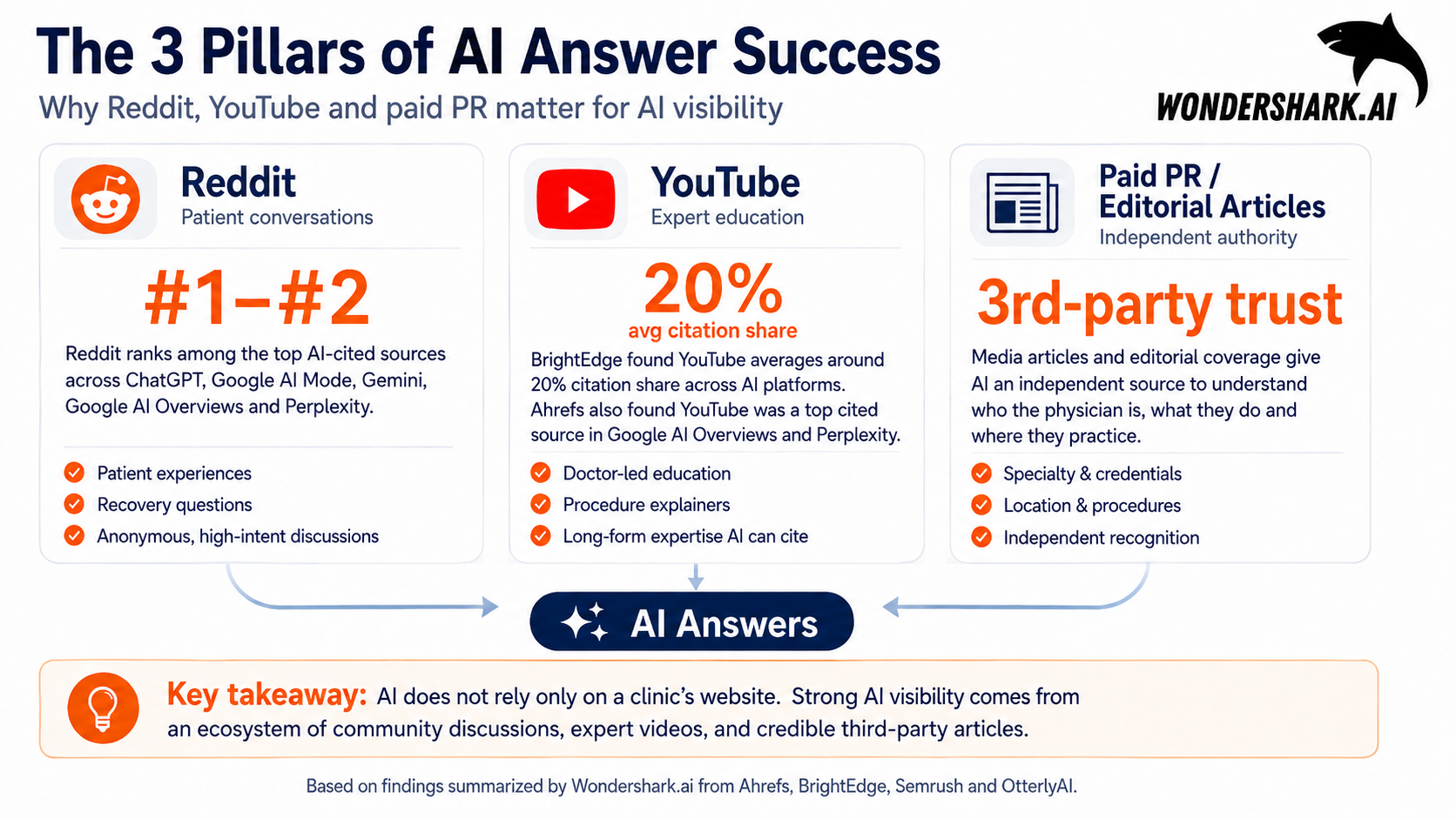
According to a June 2025 Semrush analysis of over 150,000 LLM citations, Reddit was the most cited domain across AI platforms at 40.1% - beating Wikipedia at 26.3%, YouTube at 23.5%, and Google itself at 23.3%. That number genuinely surprised a lot of people. It shouldn't have. Reddit is exactly what AI models love: unfiltered, experience-based, community-validated answers written in plain language.
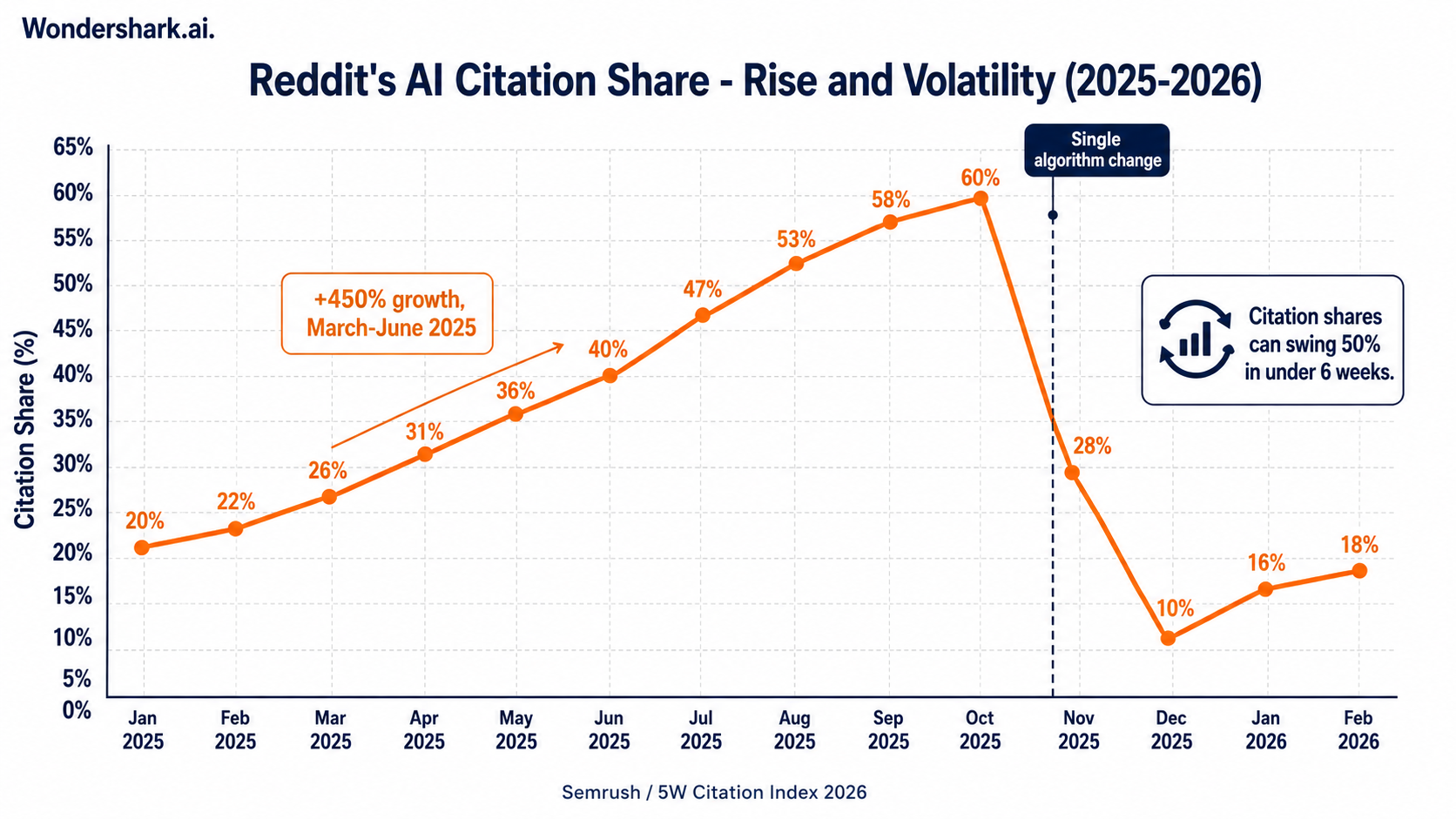
But here's the part most people skip over. Reddit's AI citation share dropped roughly 50% between October 2025 and January 2026, after a single Google parameter change caused ChatGPT's Reddit citation share to fall from 60% to 10% in just six weeks. When Reddit is cited, it tends to own the conversation - AI models still heavily favor Reddit for recommendation, comparison, and "what's actually good" queries. But it doesn't dominate everything anymore, and it can lose ground fast when platforms adjust their parameters.
The implication is straightforward: Reddit is not a spray-and-pray channel. You need to show up in the right threads for the right queries - and you need presence elsewhere too, because citation share volatility is now a baseline condition, not an edge case.
The Experiment That Settled the Debate
The most shared finding in SEO communities over the past few months came from Andrew Shotland at Local SEO Guide. He ran a controlled test: 100 brand mentions and 100 comments in relevant Reddit threads over one month for a SaaS client. Before the test, the brand appeared in roughly 8-9% of tracked AI Overview prompts. Within a couple of weeks, it was approximately 3x that. And when they stopped, it went straight back down.
That's about as close to a smoking gun as you're going to get in this space. Brand mentions on Reddit directly influence AI citation rates, and the effect is not permanent - the moment you stop, the signal fades. What Shotland's research also confirmed is that Reddit mentions, organic rankings, and authoritative citations aren't isolated signals. They're part of the same system. ChatGPT uses Google search results as one of its data sources. None of this operates in a vacuum.
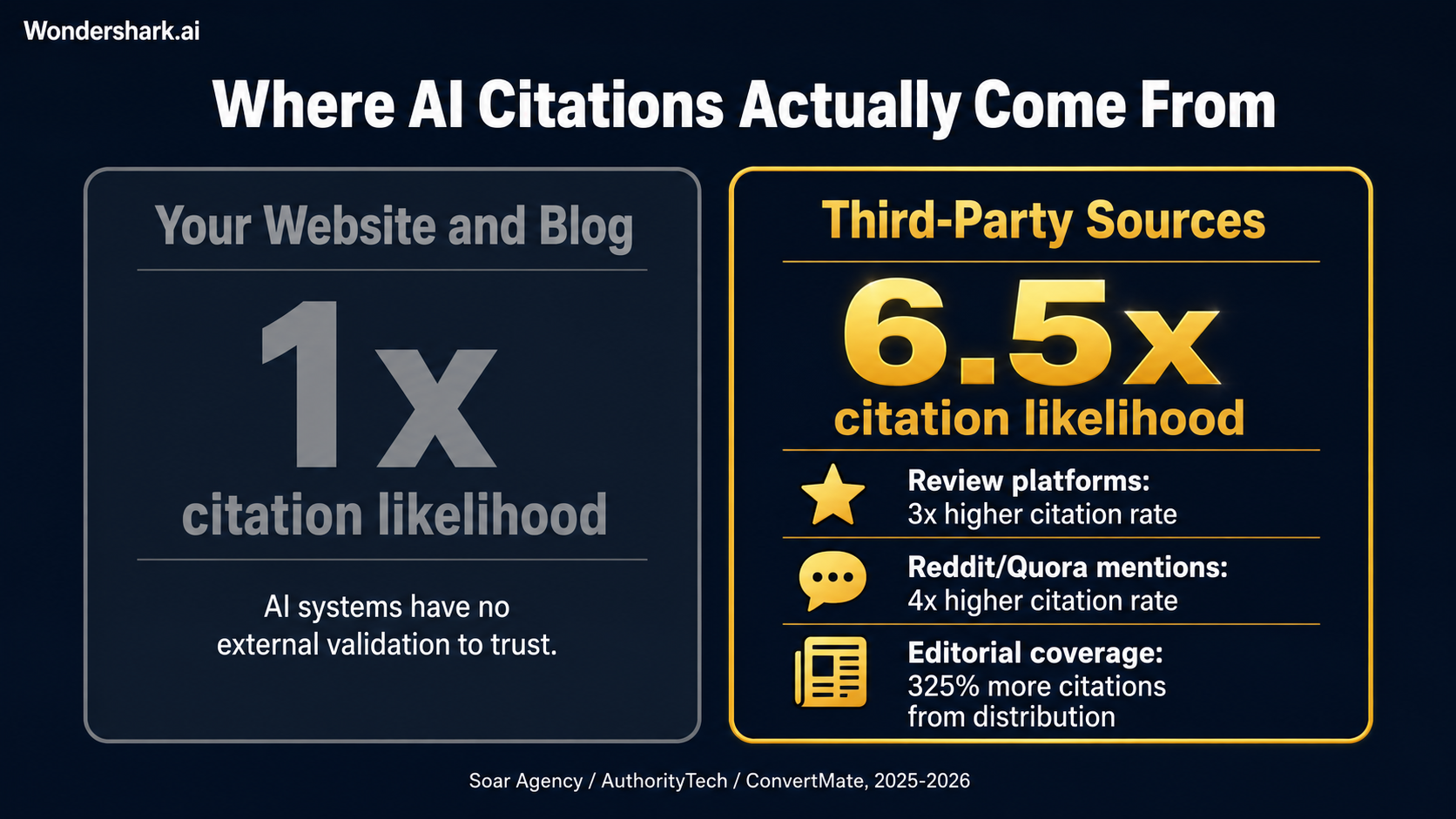
The broader data backs this up. Domains with millions of brand mentions on Quora and Reddit have roughly 4x higher chances of being cited by AI than domains with minimal community activity. Domains with profiles on Trustpilot, G2, Capterra, Sitejabber, and Yelp have 3x higher chances of being chosen as a citation source compared to brands that only live on their own website. AI systems are using third-party validation as a proxy for trustworthiness - and if your brand is only present on your own domain, you're essentially invisible to the models being asked about your category.
The stat that really drives this home: brands are 6.5x more likely to be cited through third-party sources than through their own domains. Read that again.
How to Structure Content That AI Actually Cites
Understanding that community presence matters is only half the equation. The other half is how you structure your content so AI can actually extract it. This is where most brands - even the ones that get the Reddit piece right - leave citations on the table.
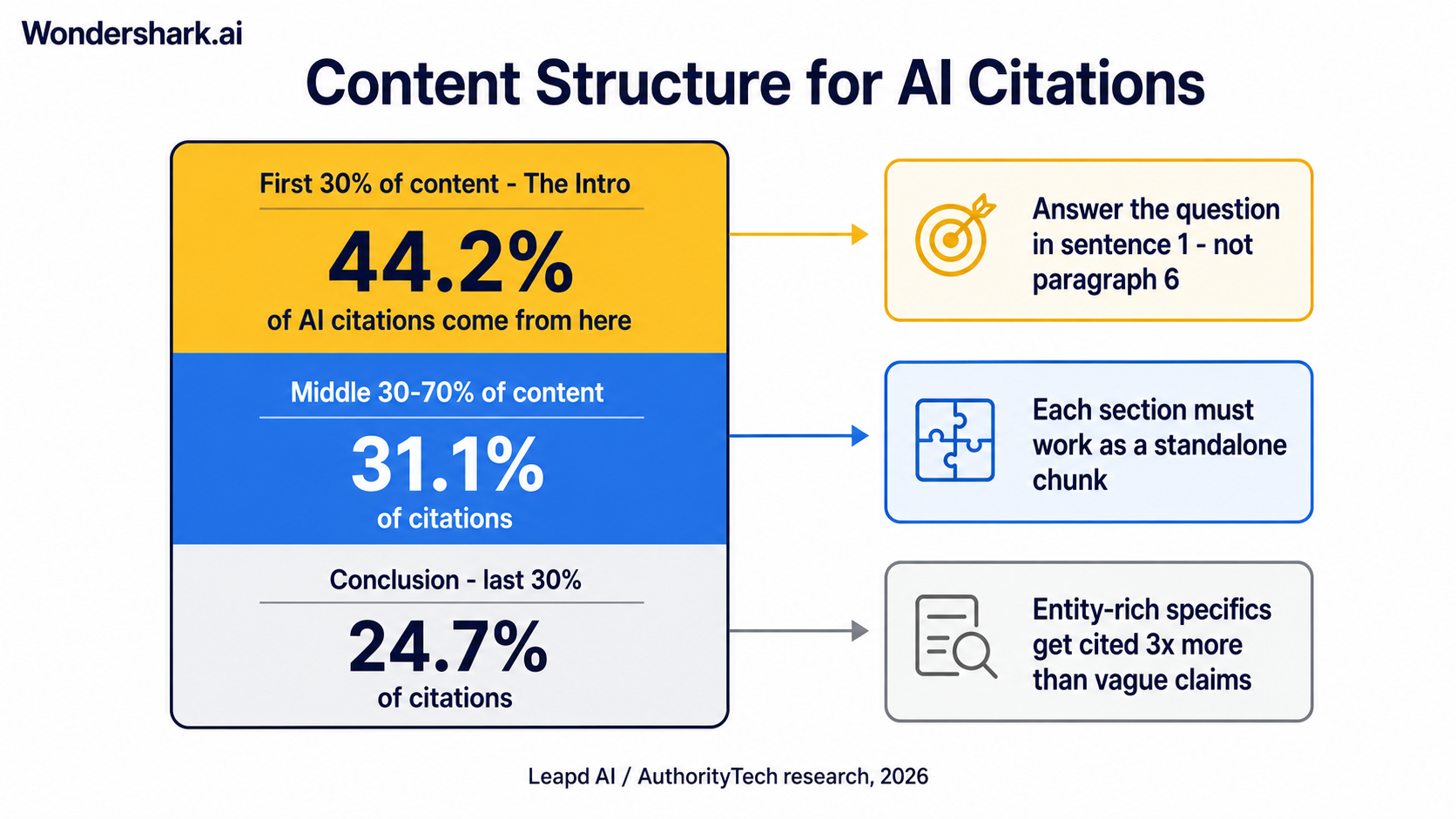
The most important structural insight from the data is that AI systems don't read your content the way a human does. They scan for extractable answers, and they stop early. 44.2% of all LLM citations come from the first 30% of a page - the intro. 31.1% come from the middle section. Only 24.7% come from conclusions. If your most useful insight is buried in paragraph six, it might as well not exist. The first sentence of any piece should answer the primary question completely. Every section should be able to stand alone, because AI models pull individual chunks, not full documents.
On Reddit specifically, entity-rich posts - ones with specific product names, data points, and concrete outcomes - are cited 3x more often than vague recommendations. "Company X is great" will not be cited. "I switched from Tool A to Tool B for this specific reason, and here's what happened over 90 days" will be. AI models reward specificity and structure, not enthusiasm.
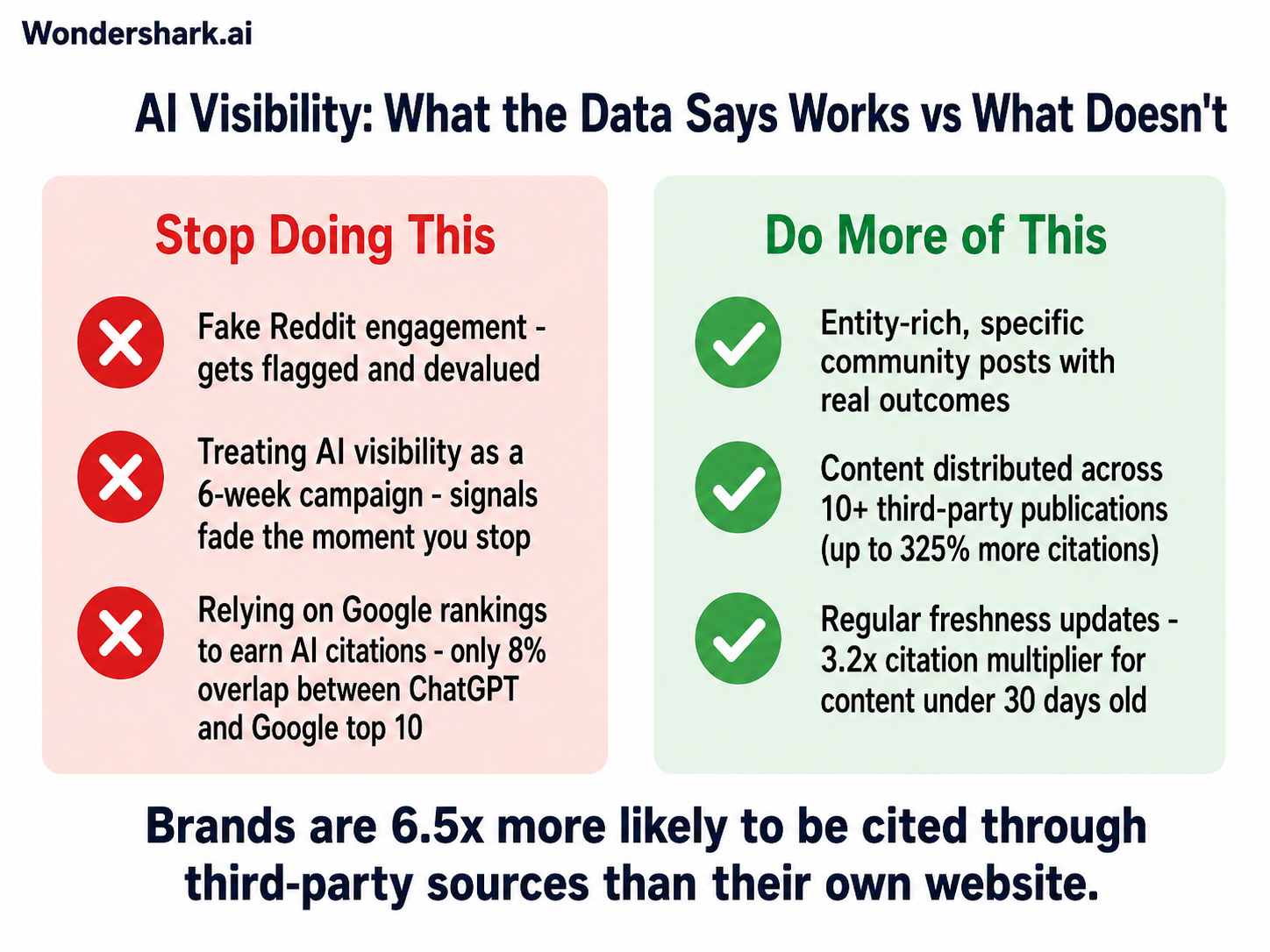
Distribution matters more than most people realize. Distributing content to a wide range of publications can increase AI citations by up to 325% compared to only publishing on your own site. And yet most brands are still treating their own blog as the only content property that counts. Additionally, content freshness is a real citation multiplier - pages updated within the last 30 days see a 3.2x citation multiplier compared to older content. Stale content isn't just less useful to readers - it's actively penalized in AI citation logic.
What Doesn't Work
The data is pretty clear on what to avoid, even though a lot of brands are still doing it.
Fake Reddit engagement is a waste of time and actively damaging. AI platforms, Reddit's own moderation systems, and Google can all detect manufactured engagement - five accounts less than a month old all praising the same company in the same subreddit is not a subtle signal. The short-term boost in mentions isn't worth the long-term damage to trust signals, and the effect is usually short-lived anyway.
Keyword stuffing dressed up as GEO is the other big failure mode. Most agencies selling "AEO services" right now are repackaging SEO fundamentals with new terminology and charging more for it. The underlying shift is real. But thinking GEO is a tactic rather than a structural change in how AI selects sources is a fundamental misunderstanding of what's happening.
The more subtle mistake is treating AI visibility as a campaign with a start and an end. Andrew Shotland's experiment showed what happens when you stop: citations drop. This is reputation infrastructure. It takes months to build and it needs to be maintained. Brands that run a six-week Reddit push and then move on will see the signal fade. The ones building consistent, sustained presence in relevant communities are the ones that compound over time.
One more thing: SparkToro found there is less than a 1 in 100 chance that ChatGPT and Google will give the same recommendation for identical queries. If your strategy is "we'll just rank well on Google and AI will follow," the data says that won't work. Only 8% of ChatGPT results overlap with Google's top 10. AI citation logic is decoupling from traditional search rankings fast, and that gap is widening.
Why the Conversion Numbers Change the Conversation
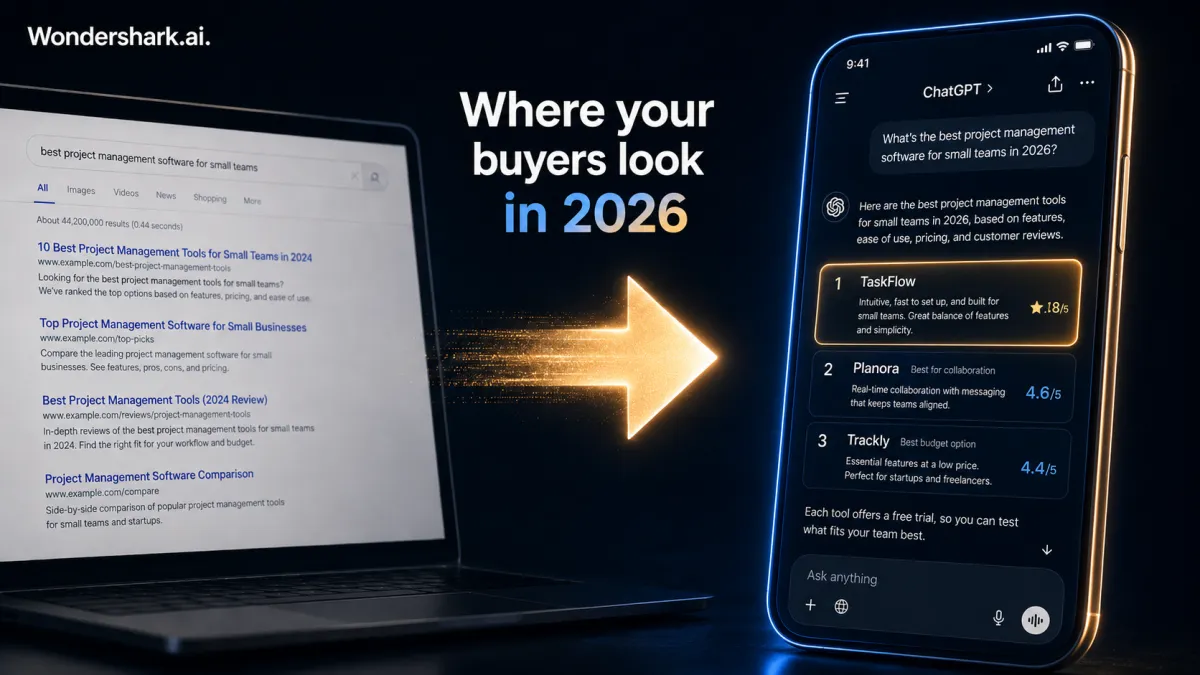
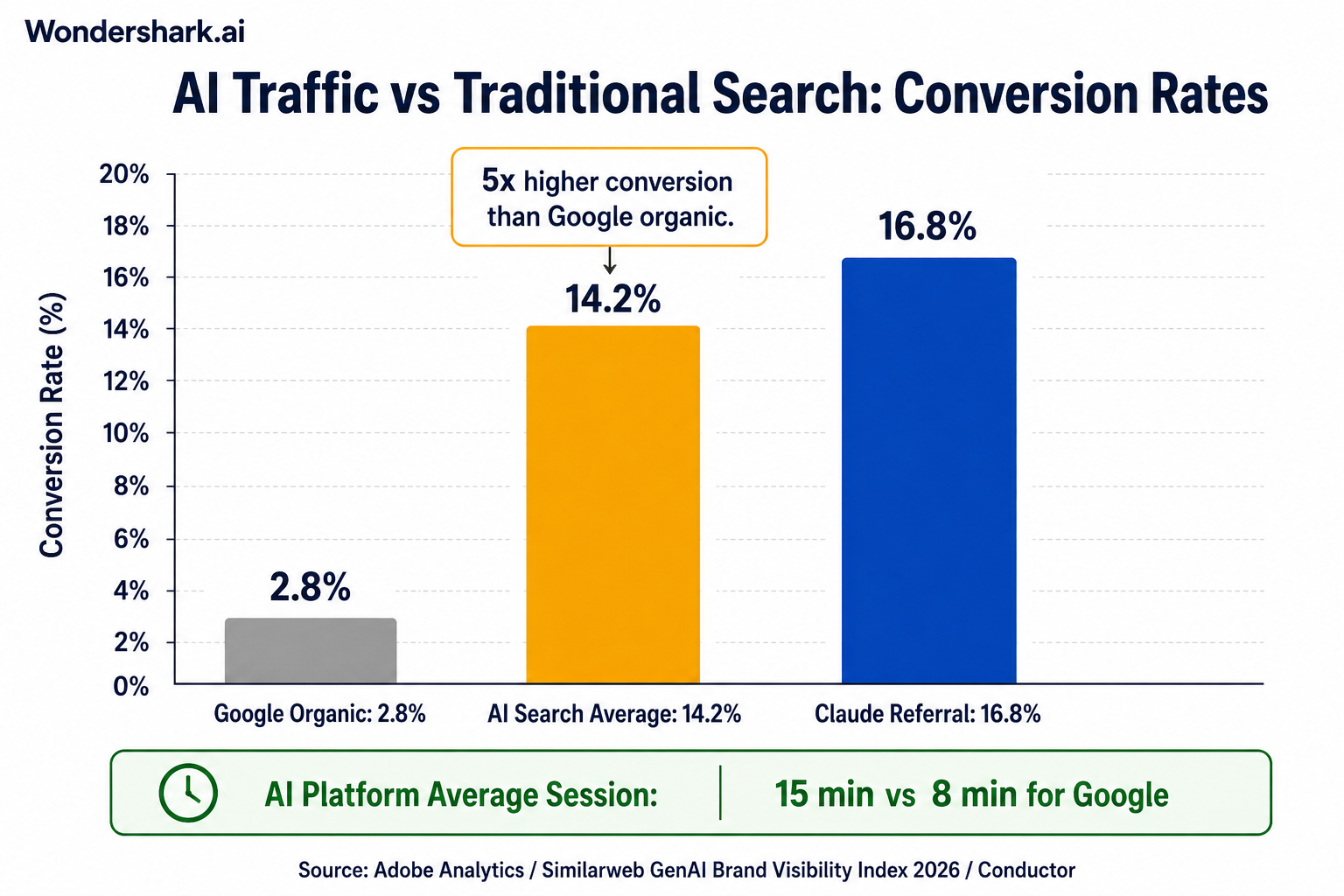
Here's the stat that should settle every internal argument about whether AI visibility is worth the investment. AI search traffic converts at 14.2% compared to 2.8% for Google organic - a 5x difference. Claude referral traffic converts even higher at 16.8%. The Washington Post found that visitors arriving from AI platforms converted to subscriptions 4-5x more than visitors from traditional search. Similarweb's 2026 GenAI Brand Visibility Index found that users arriving from ChatGPT spend an average of 15 minutes on site and generate 12 page views, versus 8 minutes and 9 pages from Google referrals.
AI referral traffic is currently around 1.08% of total web traffic, still small in volume terms. But writing it off because of that volume misses the conversion story completely. And the volume is growing. AI Overviews now reach 1.5 billion monthly users and appear in roughly 50% of all searches. ChatGPT alone processes 2.5 billion prompts daily and drives 87.4% of all AI referral traffic. The audience is already massive. The conversion quality is already there. The only question is whether your brand is in the answers those users are getting.
The GEO market is valued at $848 million in 2025 and projected to reach $33.7 billion by 2034 - a 50.5% compound annual growth rate. 54% of US marketers plan to implement GEO within the next 3-6 months. This is moving from early adopter territory to mainstream fast.
What We've Learned from 10,000+ Tests
At Wondershark.ai, we've tested over 10,000 AI prompts and brand mentions to understand what actually drives citation patterns in practice. The finding that keeps coming up is this: AI systems don't reward content. They reward consistency of presence across credible, third-party sources. The brands that get cited aren't necessarily the biggest or the best-funded. They're the ones showing up repeatedly, in the right communities, in the right format, with real specificity.
Vague content is invisible to AI. Concrete, experience-based, entity-rich answers are what get pulled into responses. And out of more than 18 million domains in Google's index, only about 274,000 have ever appeared in an AI Overview. That concentration is tightening - the top 15 domains already hold 68% of all AI citation share. The brands building citation authority now are locking in positions that will be significantly harder to take from 12 months from now.
The playbook for 2026, based on everything the data shows, comes down to four things. Build genuine community presence - especially on Reddit, but not only Reddit. Distribute content across third-party platforms rather than treating your own blog as the only property that matters. Structure every page so an AI can extract a clean answer from the first paragraph. And track citation rates across all major AI platforms as a real metric, not an afterthought.
Everyone is going to call themselves a GEO expert in 2026. The ones actually winning are the ones quietly doing the work: showing up in the right communities, providing real answers, and building the kind of third-party presence that makes AI systems trust them by default. That work is unglamorous, and it takes longer than a campaign. It's also the only thing that compounds.
Want to See Where Your Clinic Stands?
At Wondershark.ai, we measure how physicians and medical clinics appear across leading AI platforms, compare their visibility with competing physicians, and identify the sources influencing those answers.
We also establish your current AI visibility and determine the visibility target you need to reachyour desired number of new consultations and patients.
If you want to see where your clinic stands in AI search, we can show you how visible you are today, where the biggest opportunities are to improve, and how much additional visibility may be needed to achieve your patient-growth goals.
Frequently Asked Questions
What makes content more likely to be cited by AI?
AI platforms generally favor content that is clear, specific, useful, current, and supported by credible evidence. The content should directly answer a real question and provide information that can be extracted without losing its meaning.
Why are third-party sources important for physicians?
A clinic’s website communicates what the clinic says about itself. Reviews, publications, interviews, professional profiles, videos, directories, and credible community discussions provide independent signals that can validate the physician’s expertise and reputation.
Is Reddit essential for medical AI visibility?
Reddit can be highly influential for questions involving patient experiences, comparisons, recovery, costs, and recommendations. However, its importance varies by specialty and platform, so it should be one component of a broader authority strategy.
How should physicians participate in Reddit discussions?
Participation should be transparent, accurate, educational, and genuinely useful. Physicians and clinics should avoid fake patient accounts, disguised advertising, manufactured praise, or promotional comments that violate community rules.
What is entity-rich medical content?
Entity-rich content clearly identifies the physician, clinic, procedure, location, credentials, relevant organizations, and measurable facts. It replaces vague claims with specific information that AI platforms can understand and connect.
What is an example of weak versus strong content?
“Dr. Smith is an excellent surgeon” is vague and difficult to verify. A stronger statement identifies Dr. Smith’s specialty, location, credentials, procedure focus, and specific experience while supporting those facts with credible sources.
How should medical content be structured for AI extraction?
Begin with a direct answer, followed by descriptive headings, short self-contained sections, evidence, examples, and FAQs. Each section should make sense even if an AI platform extracts it without the rest of the article.
Does content freshness affect AI citations?
Current information can improve usefulness, particularly for changing medical guidance, technology, procedures, and market information. However, updating the publication date without meaningfully improving the content is unlikely to create lasting value.
Does traditional SEO still matter?
Yes. Search rankings and technical accessibility can help AI platforms discover content, but strong Google performance does not guarantee inclusion in ChatGPT, Gemini, Perplexity, or other AI-generated answers.
What AI visibility tactics are mostly hype?
Keyword stuffing, generic AI-generated articles, fake Reddit activity, manufactured reviews, vague “GEO optimization” packages, and one-time citation campaigns are unlikely to build sustainable authority.
Can a short-term campaign create permanent AI visibility?
Usually not. Citation patterns can change when content activity, community presence, or third-party mentions stop. AI visibility should be treated as ongoing reputation and authority infrastructure.
Should a medical practice publish only on its own website?
No. The website is the foundation, but authority should also appear across relevant publications, medical directories, professional profiles, YouTube, interviews, review platforms, and credible patient communities.
How should physicians measure AI visibility?
Track how often the physician appears for relevant patient prompts, recommendation position, cited sources, sentiment, answer accuracy, competitor visibility, AI referral traffic, consultation requests, and new-patient acquisition.
Do more AI citations automatically produce more patients?
No. Citations create visibility and authority, but patient growth also depends on the relevance of the prompts, the clinic’s reputation, website experience, offer, follow-up process, consultation availability, and conversion rates.
Will the same strategy work across every AI platform?
Not necessarily. ChatGPT, Gemini, Perplexity, Google AI experiences, Claude, and Copilot may prefer different sources. Clinics should test the same patient prompts across multiple platforms and adjust based on the results.