Healthcare Leads the AI Search Shift: What Physicians Need to Know Now
Healthcare is changing faster than most industries when it comes to AI search.
Key Findings
Healthcare is experiencing the largest shift toward AI search of any industry analyzed, with a reported disruption rate of 51.6%.
Patients are increasingly using ChatGPT, Gemini, Perplexity, and AI-powered Google results to research treatments, compare physicians, and identify potential providers.
AI-search traffic may be smaller than traditional search traffic today, but it can represent patients with stronger intent who are further along in their decision-making process.
Traditional SEO still matters, but ranking on Google no longer guarantees that a physician will be mentioned or recommended in AI-generated answers.
Practices should measure AI mentions, citations, consultations, and patient growth—not rely exclusively on website traffic and keyword rankings.A large WebFXstudy analyzed more than 2.37 million Google searches in the United States. It found that 51.6% of health-related searches triggered a Google AI Overview.
That was the highest percentage of any industry in the study.
For physicians who depend on online search to attract new patients, this matters. A growing part of the patient research process can now happen inside an AI-generated answer before someone visits a doctor's website.
Healthcare Is Leading the AI Search Shift
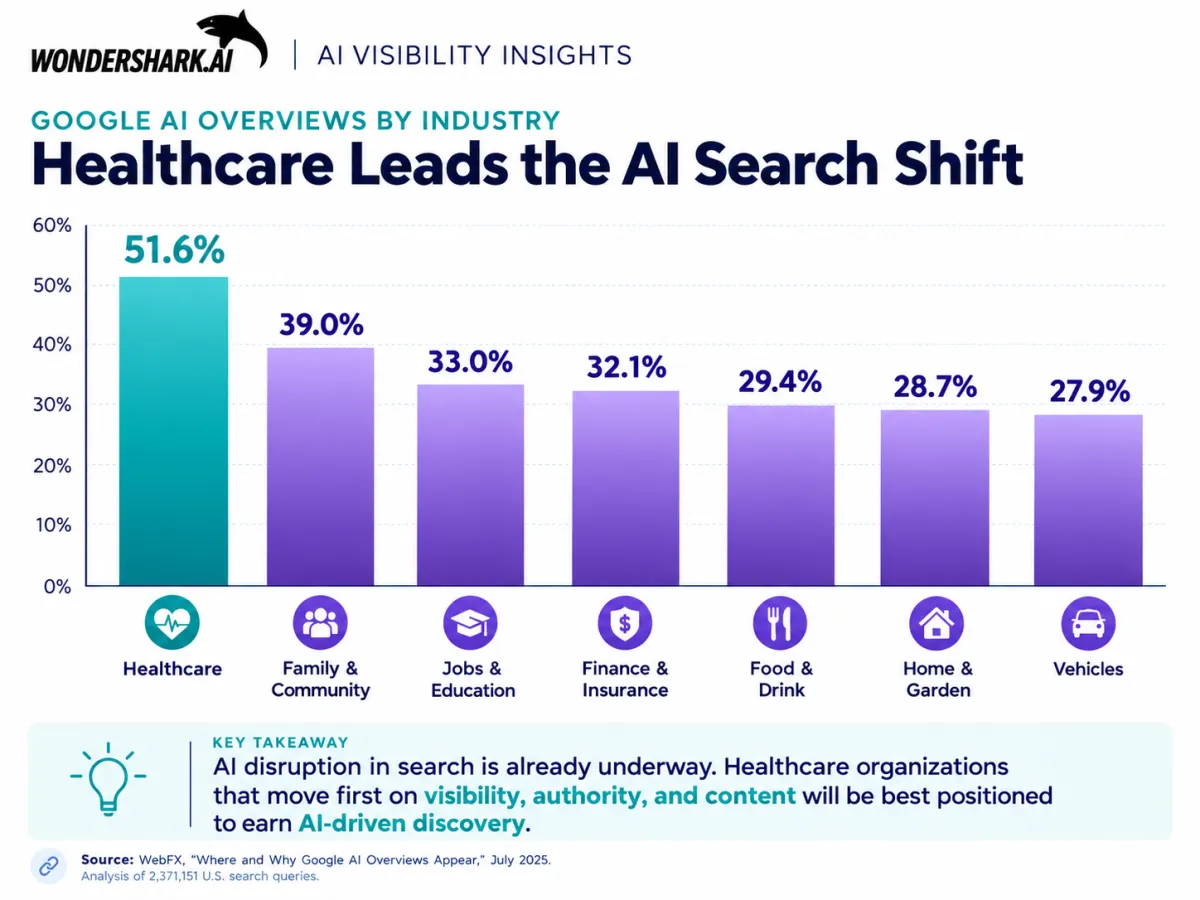
According to the WebFXanalysis of 2,371,151 U.S. searches, healthcare was well ahead of several other major categories.
Healthcare reached51.6%, compared with 39% for Family & Community, 33% for Jobs & Education, 32.1% for Finance & Insurance, 29.4% for Food & Drink, 28.7% for Home & Garden, and 27.9% for Vehicles.
WebFXlater analyzed more than 130,000 healthcare searches and found a similar pattern. According to its healthcare AI Overview study, AI Overviews appeared in about half of healthcare searches.
They appeared even more often for detailed health questions.WebFXfound AI Overviews on66.9% of informational healthcare searchesand73.9% of health searchescontainingseven or more words.
A separate Conductor AEO/GEO benchmark study analyzed about 21.9 million Google searches and foundthat 83.8% of healthcare AI referral traffic comes from ChatGPT. Healthcare again ranked first among the major industries included in the study.
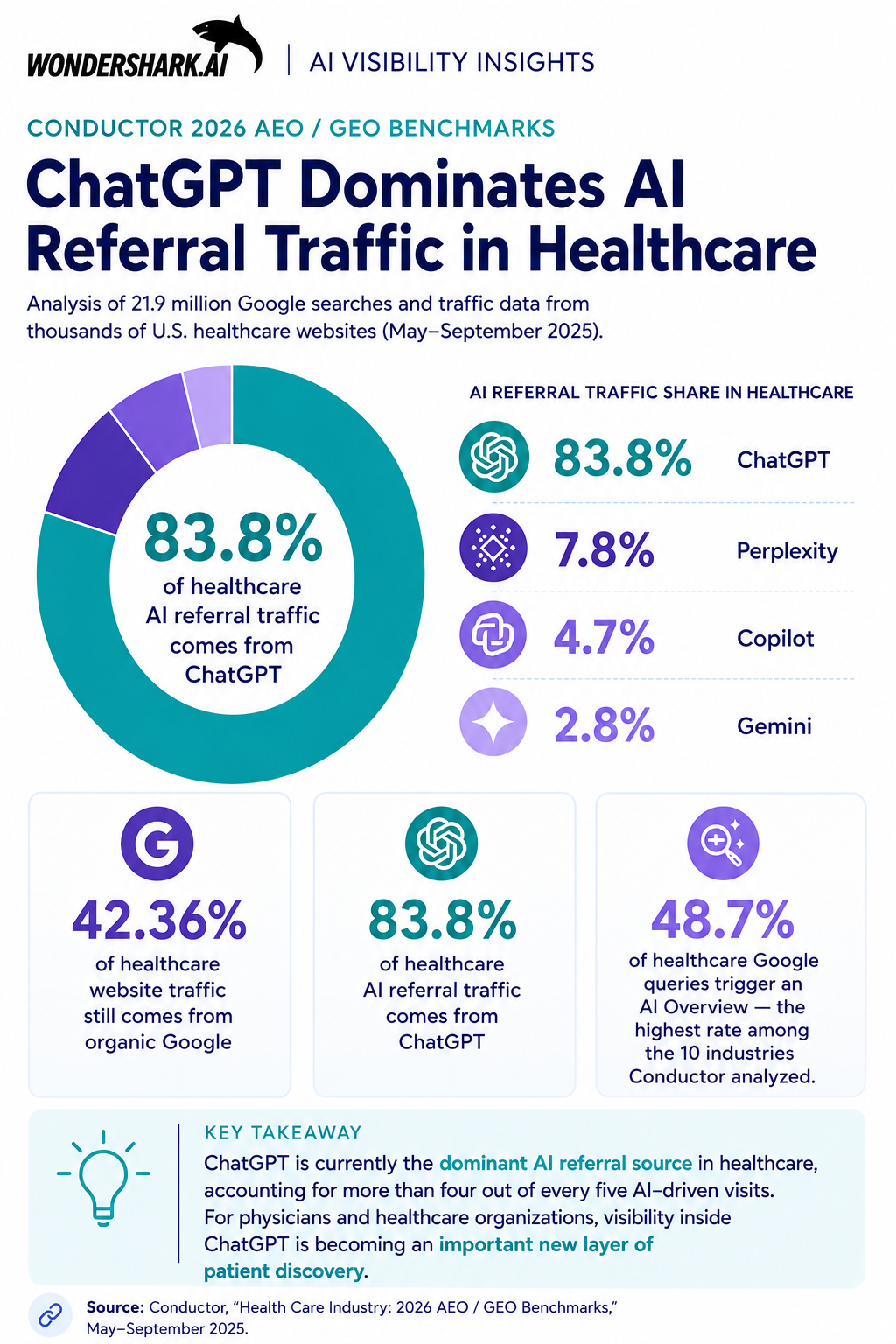
Different studies use different datasets, so the percentages will not be identical. But the direction is hard to ignore.
Healthcare is one of the industries being affected most by AI-generated search results.
For medical practices,I believe thisis something worth measuring now rather than waiting until AI visibility becomes a standard part of every marketing plan.
Why Healthcare Fits AI Search So Well
Think about how people research medical treatments.
Someone considering a facelift rarely searches once andimmediatelybooks a consultation. The same applies to dental implants, IVF, bariatric surgery, hair restoration, men's health treatments, and longevity medicine.
Patients ask questions such as:
"Who is the best facelift surgeon in Miami?"
"Who are the top hair transplant doctors in New York?"
"What should I look for in a dental implant specialist?"
"Who are the best IVF doctors near me?"
"How long does recovery from a deep-plane facelift take?"
These detailed questions are a natural fit for AI.
Traditional Google search gives the patient a list of websites. AI can give them a direct answer, explain their options, compare treatments, and sometimes recommend specific physicians.
That changes when and where a doctor can enter the patient's decision process.
A patient's first contact with your name may happen inside ChatGPT, Gemini, Perplexity, or a Google AI Overview.
Or your name may not appear at all.
The Real Problem for Physicians
Imagine that a patient asks:
"Who are the best facelift surgeons in Miami?"
AI recommends five doctors.
Your competitor appears.
You do not.
That competitor has entered the patient's consideration set before the patient has even visited a practice website.
This is why physicians should start asking a new question:
"When a patient asks AI who they should choose, does my name appear?"
That is different from checking where your website ranks on Google.
A physician can have a strong website, excellent reviews, and a respected reputation but still have weak visibility in AI-generated answers.
AI Looks Beyond Your Website
Your website matters, but AI can use information from many other places when building an answer.
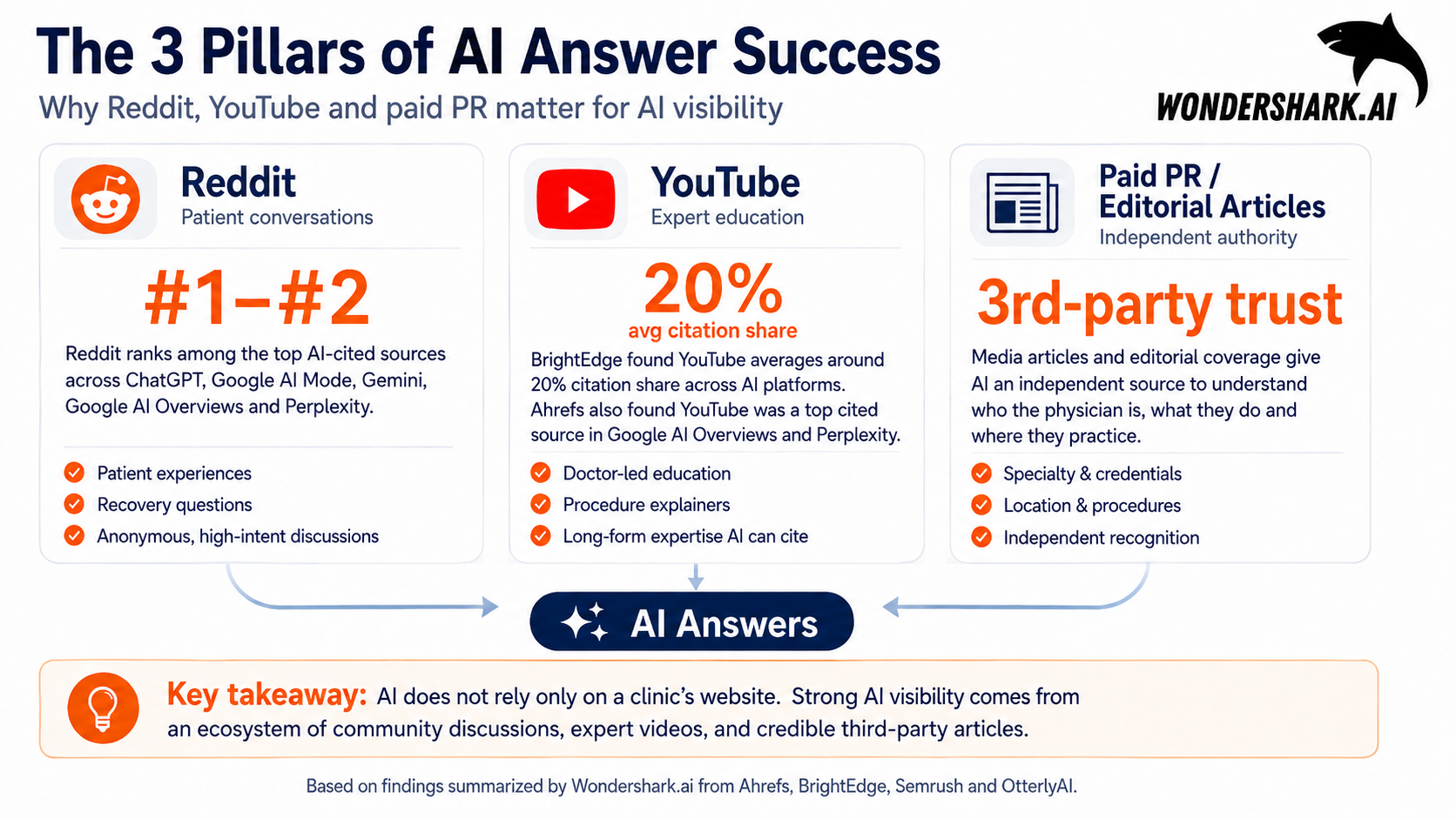
That can include articles, interviews, videos, medical directories, professional profiles, reviews, publications, online discussions, and other third-party sources.
AI needs to understand who you are, what you specialize in, where you practice, which procedures you are known for, and what other sources say about you.
If those signals are weak or inconsistent, another physician may simply be easier for AI to understand and recommend.
This is where WonderShark.ai comes in.
How WonderShark.ai Helps Physicians
1. Measure Your AI Visibility
We start with the questions patients areactually askingabout your specialty, procedures, and market.
WonderShark.ai measures how often your name appears across leading AI platforms and compares your visibility with competing physicians.
For example, you may rank well when someone searches your name but rarely appear when a new patient asks:
"Who is the best facelift surgeon in Miami?"
Those discovery searches are where the biggest opportunity may exist.
2. Find Out Why Competitors Appear
Next, we look at the physicians AI recommends more often.
We analyze the sources connected to those answers andidentifythe gaps between their online presence and yours.
That might include stronger articles, better videos, more third-party mentions, clearer procedureexpertise, or more consistent connections between a physician, a treatment, and a location.
This gives us a clearer idea of what needs to change instead of simply creating more content and hoping it works.
3. Build the Signals That Matter
Once we know the gaps, we work on theareasmost likely to improve your visibility.
That can include website content, videos, interviews, articles, professional profiles, third-party mentions, and relevant online discussions.
The goal is simple.
Make it easier for AI to understand who you are, what you are known for, and why you are relevant to the patient's question.
Connect AI Visibility to Patient Growth
Most physicians do not care about an AI visibility percentage by itself.
They care about consultations and patients.
That is why WonderShark.ai first identifies your current AI visibility and then determines the visibility target you may need to reach your desired number of new consultations and patients.
We can model what stronger AI visibility could mean for your practice using factors such as your specialty, procedure value, geographic market, estimated patient search demand, current and target visibility, and clearly stated conversion assumptions.
These forecasts are estimates, not guarantees. However, they make the conversation much more useful.
Instead of simply saying:
“Your AI visibility increased from 10% to 30%.”
We can ask:
“What could that additional visibility mean for your practice—and how much visibility may be needed to reach your patient-growth goals?”
For physicians offering high-value procedures, even a relatively small number of additional patients can create a meaningful financial impact.
This is especially relevant in areas such as plastic surgery, dental implants, fertility, bariatric surgery, hair restoration, men’s health, and longevity medicine.
For physicians, the key question is simple:
When your next patient asks AI which doctor to choose, will your name be in the answer?
Want to See Where Your Clinic Stands?
At Wondershark.ai, we measure how physicians and medical clinics appear across leading AI platforms, compare their visibility with competing physicians, and identify the sources influencing those answers.
We also establish your current AI visibility and determine the visibility target you need to reachyour desired number of new consultations and patients.
If you want to see where your clinic stands in AI search, we can show you how visible you are today, where the biggest opportunities are to improve, and how much additional visibility may be needed to achieve your patient-growth goals.
Frequently Asked Questions
What is AI search?
AI search refers to the use of platforms such as ChatGPT, Gemini, Perplexity, and Google’s AI-powered results to receive direct answers, comparisons, and recommendations instead of reviewing a traditional list of website links.
Why is healthcare particularly affected by AI search?
Healthcare decisions involve complex questions, comparisons, and significant trust. AI platforms can summarize large amounts of information and help patients evaluate treatments, specialists, and providers more quickly.
Are patients already using AI to choose physicians?
Yes. Patients increasingly use AI platforms to research symptoms and procedures, compare providers, understand available options, and create a shortlist before contacting a medical practice.
Does AI search replace traditional SEO?
No. Strong technical SEO, useful website content, accurate local listings, and good site performance remain important. AI visibility adds another layer by determining whether a practice is understood, cited, and recommended in generated answers.
What influences whether AI recommends a physician?
AI platforms examine signals across the physician’s broader digital presence, including credentials, areas of expertise, website content, patient reviews, directory profiles, videos, and mentions from reputable third-party sources.
Why might visitors from AI search convert at a higher rate?
Someone who reaches a practice after an AI-assisted search may have already researched the procedure, compared providers, and clarified important questions. As a result, that person may arrive with stronger intent than a typical website visitor.
What should a medical practice improve first?
Begin by auditing how the physician and practice currently appear across leading AI platforms. Then correct inaccurate information, clarify areas of expertise, strengthen physician profiles, and address the most important gaps in the practice’s digital authority.
What type of content helps physicians become more visible in AI answers?
Clear physician biographies, procedure pages, patient-focused FAQs, educational articles, videos, and authoritative third-party features can all help AI systems understand what the physician does and which patients they are best positioned to help.
Do reviews and third-party mentions matter?
Yes. Consistent reviews and credible independent mentions provide external evidence of reputation, experience, and relevance. These signals can strengthen an AI platform’s confidence when evaluating potential recommendations.
How should a practice measure AI visibility?
Track how frequently the practice is mentioned or cited for relevant patient questions, which competitors appear instead, the accuracy of AI-generated information, referral traffic where available, and the consultations and patients associated with improved visibility.
Is AI visibility guaranteed to produce new patients?
No. Visibility and conversion estimates should never be treated as guarantees. However, monitoring AI visibility and connecting it to consultations and patient acquisition can help a practice make better-informed marketing decisions.
When should physicians begin preparing for AI search?
Now. AI-assisted discovery is already influencing patient research. Practices that establish accurate information, strong authority signals, and consistent visibility early may be better positioned as adoption continues to grow.