The Websites AI Search Cites Most - And What It Means for Medical Clinics
Key Findings
A strong website and Google rankings are no longer enough—AI also relies heavily on Reddit, YouTube, medical publishers, and editorial sources.
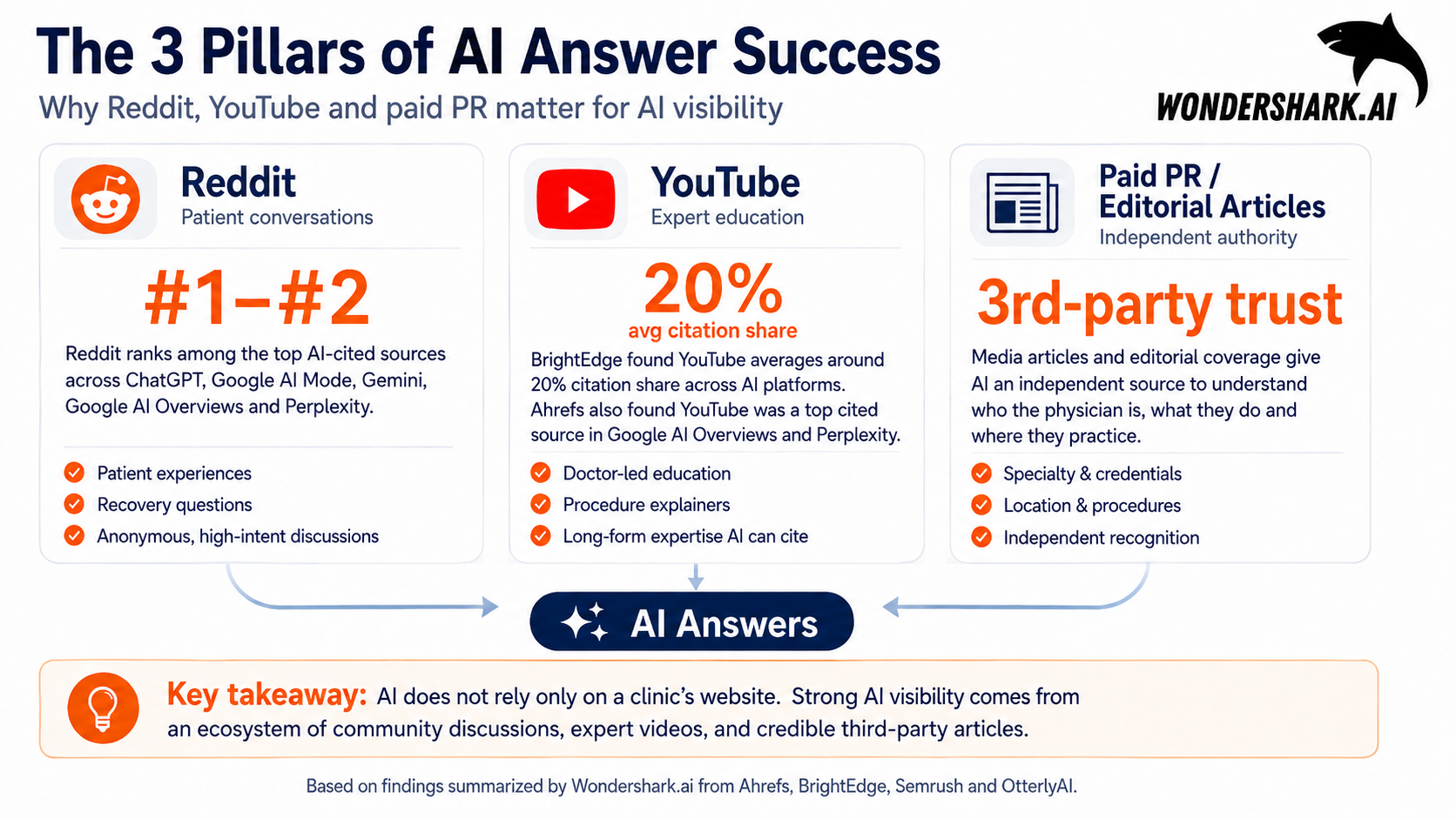
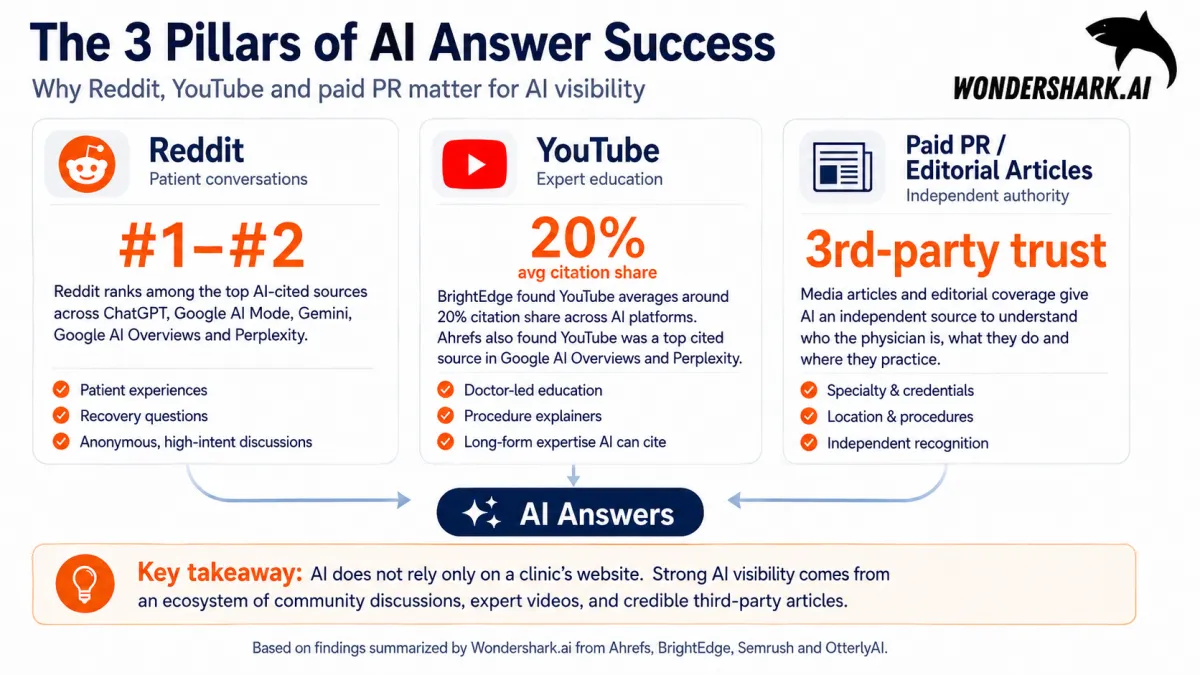
Reddit and YouTube consistently rank among the sources most frequently cited by major AI platforms.
Each AI platform uses a different and rapidly changing mix of sources, making a single-channel strategy risky.
Physicians are easier for AI to understand and recommend when their expertise appears consistently across their website, educational videos, trusted publications, and credible online discussions.Patients are starting to search differently.
Instead of typing a few words into Google and opening ten websites, they can now ask ChatGPT, Gemini, Perplexity or Google a full question.
"Who are the best facelift surgeons in Miami?"
"What should I look for when choosing a fertility clinic?"
"Which LASIK surgeons have the best reputation in Dallas?"
"What are patients saying about deep plane facelift recovery?"
AI gives them an answer. Sometimes it recommends physicians. Sometimes it compares clinics. And often, it cites the sources it used to build that answer.
That last part matters.
A clinic can have a beautiful website and strong Google rankings, but AI search may still build its answer using Reddit discussions, YouTube videos, medical publishers, news articles, review sites and other third-party sources.
Independent studies from Ahrefs, Semrush, BrightEdge and OtterlyAI all point to the same general conclusion. AI visibility is being shaped across the web, not only on your own website.
For medical clinics, I think this changes how online authority should be built.

Which Websites Are AI Platforms Citing?
There is no permanent top 10 list that applies to every AI platform. The rankings move, and each platform has its own preferences.
But when you compare the latest datasets, a few names keep coming back.
Ahrefs tracks millions of search-backed AI responses in the United States. Its July 2026 data shows the following leading sources:

Ahrefs defines "mention share" as the percentage of citations captured by a domain among the leading sources in its dataset. The data covers broad U.S. queries, so these percentages should not be interpreted as healthcare-only citation rates.
Still, the pattern is hard to miss.
Reddit and YouTube have become major source layers for AI search.
Wikipedia remains important. Large editorial sites still matter. Medical authorities matter even more when the question involves health.
For a physician, that means your AI visibility cannot depend on one type of content.

Reddit Has Become a Major AI Source
Reddit stands out more than any other community platform.
In Ahrefs' July 2026 data, Reddit ranked:
#1 in ChatGPT
#1 in Google AI Mode
#2 in Google AI Overviews
#1 in Gemini
#2 in Perplexity

YouTube Is Becoming Just as Important
YouTube is the other platform that appears again and again.
In July 2026, Ahrefs found YouTube was the #1 cited source in Google AI Overviews and #1 in Perplexity. It ranked #2 in Google AI Mode and Gemini.
BrightEdge reached a similar result in a separate study of video citations.
It found YouTube averaged around 20% citation share across the AI platforms it analyzed and received roughly 200 times more citations than the next closest video platform in its dataset.
BrightEdge also found that medical education with an action component was one of the query types likely to trigger YouTube citations.
That is a big deal for doctors.
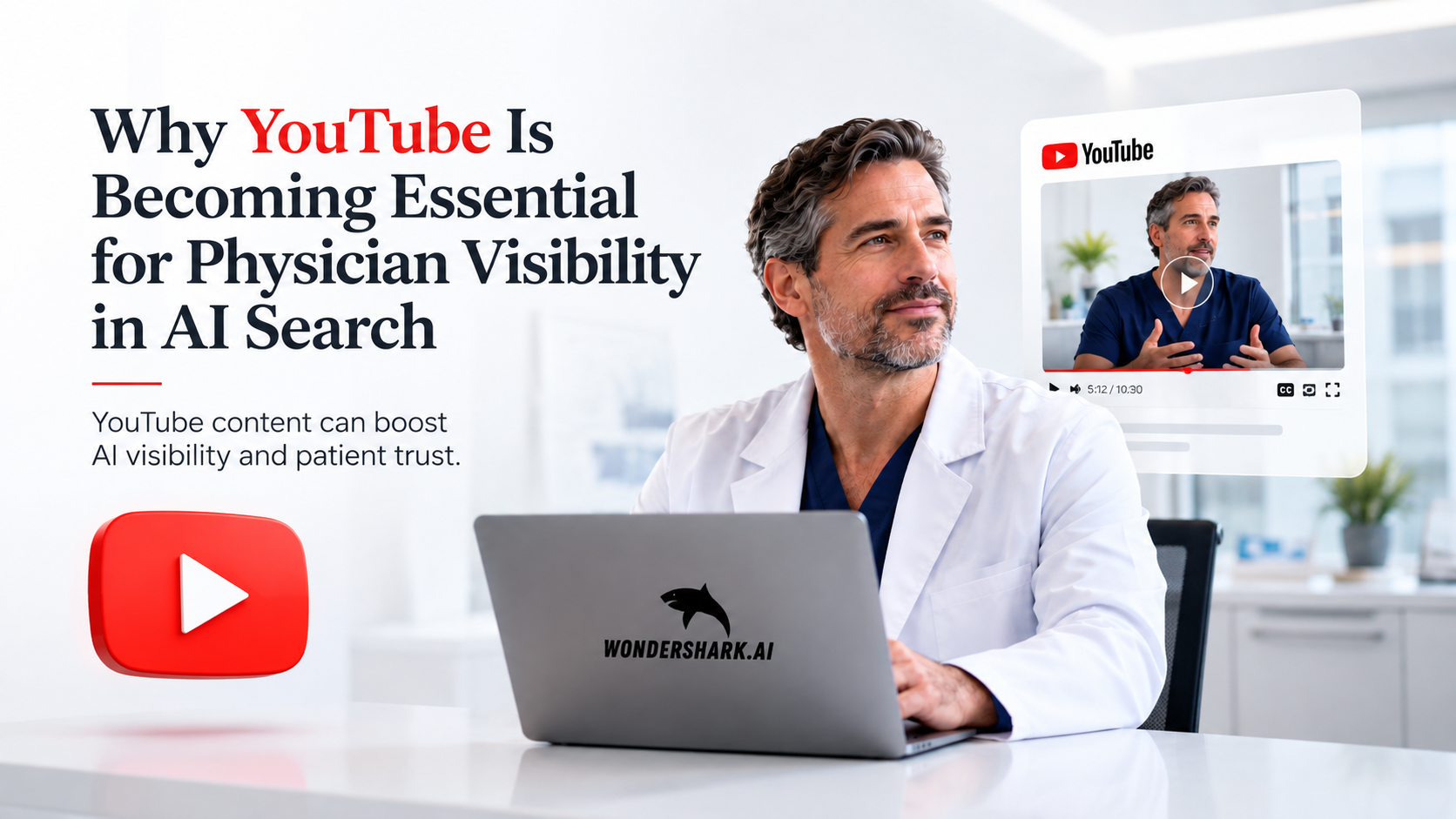
A five-minute physician video answering:
"How long does facelift recovery take?"
can serve several purposes at once.
A potential patient can discover it on YouTube. The patient can learn from the doctor before requesting a consultation. Google can find the video. AI search can potentially use the video as a source.
The video becomes more than social content.
It becomes another place where a physician's expertise exists on the open web.
For medical practices, I would put YouTube very high on the list of AI visibility channels.

A Better AI Visibility Strategy for Physicians
I would divide the work into four areas.
1- Your website
Make sure AI systems can clearly understand the physician, specialty, procedures, location, credentials and expertise. The content should answer real patient questions instead of simply repeating procedure keywords.
2- YouTube
Turn medical expertise into useful educational videos. Focus on the questions patients ask before contacting a clinic. Long-form educational content gives both patients and AI systems more context about the physician's expertise.
3- Reddit and patient conversations
Understand which discussions influence your specialty. Look at the questions patients ask, what they worry about and how they compare their options. Participation needs to be useful and transparent. Fake patient reviews or disguised promotional posts are a bad strategy, especially in healthcare.
4- Independent authority
Build credible references outside the clinic's own website. Relevant media coverage, professional profiles, medical publications, interviews and other trusted third-party sources give AI more independent information about the physician.
None of these channels replaces the others.
Together, they give AI systems more evidence to work with.
For medical clinics, my view is simple. Optimizing only the clinic website is no longer enough.
The doctors who become easiest for AI to understand and recommend will usually be the ones with clear, consistent authority across several trusted sources.
The goal is not to be everywhere.
The goal is to be present in the sources AI already uses when patients ask the questions that matter to your practice.
Want to See Where Your Clinic Stands?
At Wondershark.ai, we measure how physicians and medical clinics appear across leading AI platforms, compare their visibility with competing physicians, and identify the sources influencing those answers.
We also establish your current AI visibility and determine the visibility target you need to reach your desired number of new consultations and patients.
If you want to see where your clinic stands in AI search, we can show you how visible you are today, where the biggest opportunities are to improve, and how much additional visibility may be needed to achieve your patient-growth goals.
Frequently Asked Questions
Which websites does AI search cite most often?
Reddit and YouTube frequently rank among the most-cited sources across major AI platforms. Wikipedia, medical authorities, news publications, editorial websites, and other trusted third-party sources also play important roles.
Is a medical clinic’s website enough to build AI visibility?
No. A clinic’s website remains essential, but AI platforms also use independent sources to understand a physician’s expertise, reputation, procedures, location, and patient experiences.
Why is Reddit important for physicians?
Patients use Reddit to discuss procedures, recovery, side effects, costs, and experiences with physicians. These conversations can influence how AI platforms understand and answer patient questions.
Why does YouTube matter for AI search?
Educational videos allow physicians to answer common patient questions in depth. These videos can be discovered by patients, indexed by Google, and cited by AI platforms as sources of medical information.
Do ChatGPT, Gemini, Perplexity, and Google cite the same sources?
No. Each AI platform uses a different—and frequently changing—mix of sources. This is why relying on only one website or content channel can create significant visibility gaps.
Does traditional SEO still matter?
Yes, but it is only one part of AI visibility. Strong technical SEO and useful website content should be supported by educational videos, credible third-party coverage, professional profiles, and relevant online discussions.
Should physicians promote themselves on Reddit?
Physicians should avoid fake reviews, disguised promotions, or overly promotional posts. Any participation should be transparent, accurate, helpful, and focused on answering genuine patient questions.
How can physicians improve their visibility in AI search?
Physicians should build clear and consistent authority across four areas: their clinic website, educational YouTube content, credible patient discussions, and trusted third-party publications or professional sources.