Why YouTube Is Becoming Essential for Physician Visibility in AI Search
YouTube is emerging as one of the most important sources used by AI platforms, and for physicians, the same videos can also build patient trust and influence healthcare decisions.
Key Findings
YouTube ranked as the second most-cited domain overall in a 2026 analysis of 30 million sources used in AI-generated answers.
Educational videos help AI connect a physician’s name with specific procedures, specialties, locations, and patient questions.
Each video becomes a long-term digital asset that can appear on YouTube, Google, clinic websites, and AI platforms.
The same content also educates prospective patients, demonstrates expertise, builds familiarity, and can influence consultation decisions.
Physicians do not need millions of views—reaching a smaller audience of highly qualified patients can be far more valuable.
Patients are increasingly asking AI platforms questions that were once typed exclusively into Google:
Who is the best plastic surgeon for a facelift in my area?
Which doctor specializes in complex dental implants?
What should I know before choosing an IVF clinic?
Who are the leading surgeons for this procedure?
Platforms such as ChatGPT, Gemini, Google AI Mode, Google AI Overviews and Perplexity are increasingly influencing how people research physicians, procedures and medical providers.
For physicians, this creates a new marketing challenge:
It is no longer enough to rank well in traditional search. Your expertise also needs to be visible in the sources AI platforms use to build their answers.
And YouTube is becoming one of the most important of those sources.
YouTube Is One of the Most Cited Sources in AI Search
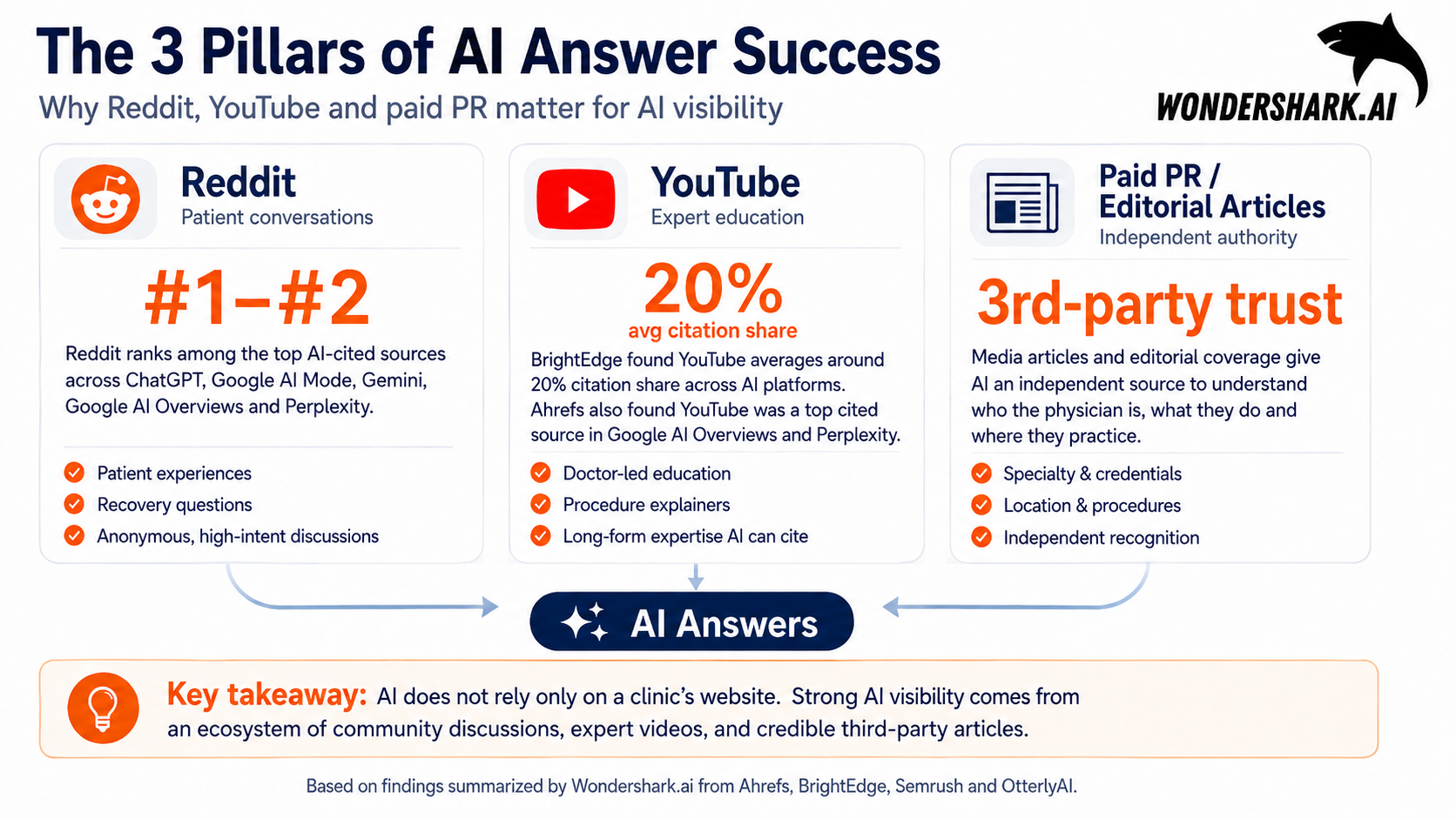
A 2026 analysis reported by Search Engine Land examined 30 million sources cited in AI-generated answers across ChatGPT, Gemini, Google AI Mode, Google AI Overviews and Perplexity.
Across the combined dataset:
#1 Reddit
#2 YouTube
#3 LinkedIn
#4 Wikipedia
#5 Forbes
The significance for physicians is substantial.
YouTube is no longer simply a platform where prospective patients may discover a medical video.
Its content can also become part of the information ecosystem that AI platforms analyze, reference and cite when answering questions.
A physician who consistently publishes educational videos about specific procedures, conditions and patient questions creates additional digital signals connecting:
their name + their specialty + their procedures + their geographic market + their medical expertise.
That can strengthen the physician's overall presence in AI search.

Video Helps AI Understand What a Physician Is an Expert In
AI visibility depends partly on the information available across authoritative and relevant digital sources.
YouTube gives physicians an opportunity to publish detailed educational content around very specific topics.
For example, a plastic surgeon might create videos answering:
What is a deep-plane facelift?
Deep-plane facelift vs. traditional facelift
Who is a good candidate for a neck lift?
How long is facelift recovery?
What should patients look for when choosing a facelift surgeon?
Each video creates another piece of searchable and machine-readable content associated with that physician's expertise.
Video titles, descriptions, transcripts and the content of the video itself can provide additional context about who the physician is, what they specialize in and which patient questions they are qualified to answer.
Instead of relying entirely on a practice website to establish expertise, YouTube allows physicians to build a much larger body of topical content around their name.
One Physician Can Build Visibility Across Hundreds of Patient Questions
Patients rarely search for a physician using only one question.
Someone considering breast augmentation, for example, might ask:
What size implant should I choose?
Then:
Silicone or saline?
Then:
Over or under the muscle?
Then:
How long is recovery?
And eventually:
Who is the best breast augmentation surgeon near me?
A strong YouTube strategy allows a physician to create content around this entire journey.
Over time, that creates a library of expertise covering many of the questions AI platforms may encounter when patients research that procedure.
This is one reason video can become a powerful component of an AI visibility strategy.
The objective is not simply to generate YouTube views.
The objective is to increase the number of authoritative digital assets that connect the physician with the topics prospective patients are asking AI about.
YouTube Content Can Keep Working Long After Publication
Unlike a temporary advertising campaign, a useful educational video can remain online and discoverable for years.
A single video can potentially:
appear in YouTube searches,
surface in Google,
be embedded on the physician's website,
be shared with prospective patients,
be repurposed into short-form content,
generate transcripts and contextual information,
and contribute to the physician's broader footprint across AI search.
Every new video therefore becomes another long-term visibility asset.
And as the physician's video library grows, so does the amount of authoritative content connecting their name with specific procedures and areas of expertise.
AI Visibility Is the Primary Advantage — But Not the Only One
The strategic value of YouTube does not stop with AI search.
The same videos being created to strengthen a physician's digital and AI presence are also viewed directly by prospective patients.
That creates a second major benefit:
YouTube can build familiarity, trust and patient demand before someone ever contacts the practice.
Patients Already Use YouTube to Make Healthcare Decisions
A 2024 study published in BMC Public Health examined how people use health-related YouTube content.
Among 3,000 participants, researchers found that more than 40% reported using YouTube health content when deciding whether to consult a doctor.
This is important because it shows that medical video does not simply generate awareness.
It can participate directly in the patient's decision-making process.
A prospective patient may watch a physician explain a procedure several times before ever visiting the practice website or requesting a consultation.
By that point, the physician is no longer a completely unfamiliar provider.
The patient has already spent time learning from them.

Physicians Can Reach a Massive U.S. Audience
The scale of YouTube also makes it difficult to ignore.
According to Pew Research Center, 84% of U.S. adults use YouTube.
For physicians, however, the objective is not necessarily to generate millions of views.
What matters is reaching the right people.
A highly specialized educational video may attract a relatively small audience but still be extremely valuable if those viewers are actively researching a procedure the physician performs.
A surgeon does not need one million viewers.
They may need one hundred highly qualified prospective patients researching exactly the procedure they specialize in.

Video Can Influence Appointments
Research from Google on the healthcare decision journey also demonstrated the connection between online video and patient action.
In Google's healthcare research, 30% of patients who watched an online healthcare video went on to schedule an appointment.
The study is older and should be interpreted in that context, but the finding illustrates an important principle:
Healthcare video can move people beyond education and toward action.
More recent research showing that patients use YouTube to decide whether to consult physicians reinforces the same underlying behavior.

The Same Video Can Serve Two Strategic Purposes
This is what makes YouTube unusually valuable for physicians.
1. Increase Visibility in AI Search
Educational videos expand the physician's digital footprint around the procedures, specialties and questions prospective patients are asking.
With YouTube now ranking among the most frequently cited domains in major AI platforms, that content can contribute to stronger visibility across the emerging AI-search ecosystem.
2. Build Trust and Patient Demand
The same content is consumed directly by prospective patients.
It educates them, demonstrates expertise, creates familiarity and can influence whether they decide to contact a physician.
One content strategy therefore supports both AI discovery and patient acquisition.
At Wondershark.ai, we measure how physicians and medical clinics appear across leading AI platforms, compare their visibility with competing physicians, and identify the sources influencing those answers.
We also establish your current AI visibility and determine the visibility target you need to reachyour desired number of new consultations and patients.
If you want to see where your clinic stands in AI search, we can show you how visible you are today, where the biggest opportunities are to improve, and how much additional visibility may be needed to achieve your patient-growth goals.
Frequently Asked Questions
Why is YouTube important for physician visibility in AI search?
YouTube is one of the sources most frequently cited by major AI platforms. Educational videos give AI additional information it can use to understand a physician’s expertise and answer patient questions.
How do YouTube videos help AI understand a physician’s expertise?
Video titles, descriptions, transcripts, and spoken content can associate the physician’s name with particular specialties, procedures, locations, and medical questions. A growing video library creates a broader body of searchable information around that expertise.
What types of videos should physicians create?
Physicians should answer the questions patients ask throughout their decision-making journey. Strong topics include candidacy, procedure comparisons, recovery, risks, expected outcomes, and what to consider when choosing a physician.
Do medical videos need millions of views to be valuable?
No. A specialized video watched by a smaller number of highly qualified prospective patients can be more valuable than a general video attracting a large but irrelevant audience.
Can a YouTube video continue producing value after publication?
Yes. A useful educational video can remain discoverable for years through YouTube, Google, clinic websites, and AI search. It can also be repurposed into short-form videos, articles, transcripts, and patient education materials.
Can YouTube influence whether patients schedule a consultation?
Yes. Research cited in the article found that more than 40% of participants used YouTube health content when deciding whether to consult a physician. Video can educate patients, create familiarity, and move them closer to contacting a practice.
How does video build patient trust?
Video gives prospective patients time to hear a physician explain complex medical decisions and understand their approach. This familiarity can be especially valuable for high-consideration services such as plastic surgery, fertility treatment, dental implants, bariatric surgery, and hair restoration.
Does YouTube replace a physician’s website or traditional SEO?
No. YouTube expands the physician’s digital footprint and complements the clinic website, traditional search visibility, professional profiles, publications, and other sources used by AI platforms.
How can one medical video be used across multiple channels?
The full video can appear on YouTube, be embedded on the clinic’s website, shared with prospective patients, and divided into shorter clips. Its transcript can also support articles, FAQs, social posts, and other educational content.