How to Get LinkedIn Posts Cited by AI | Wondershark.ai
How to Get Your LinkedIn Posts Cited by AI
A practical guide for doctors and medical practices
By Wondershark.ai | Updated November 24, 2026
Key Findings
LinkedIn posts and articles can appear in AI answers. Check whether yours appear for the patient questions, procedures, and locations that matter to your practice.
Start with a clear question and answer it early. Give each post one main idea, and keep important qualifications beside the claim they explain.
Use the doctor's firsthand experience and point of view. Support important claims with sources and have the physician review the content before publishing.
A focused interview with the doctor can provide material for an article and several shorter posts. Choose a pace that leaves time for proper review.
Citations, recommendations, and attended consultations measure different outcomes. Track each separately to understand where the content is helping your practice.
A useful LinkedIn post can keep working after people stop reacting to it. If an AI search tool finds it and uses it in an answer, your explanation can reach someone who has never followed you or heard of your practice. LinkedIn now publishes advice on helping both posts and articles appear in AI search.
For a doctor, that makes LinkedIn worth a closer look. You already explain your work to patients every day. Some of those explanations could become useful public answers, with your name and experience attached. At Wondershark.ai, that's where we'd start. Take the questions your patients keep asking and answer them clearly enough that someone outside the consultation room can understand them.
There's no guaranteed formula for earning a citation. But there is a practical way to build useful content, check whether AI tools find it, and see whether that visibility contributes to consultations. Here's how we'd approach it.
What we know about LinkedIn and AI
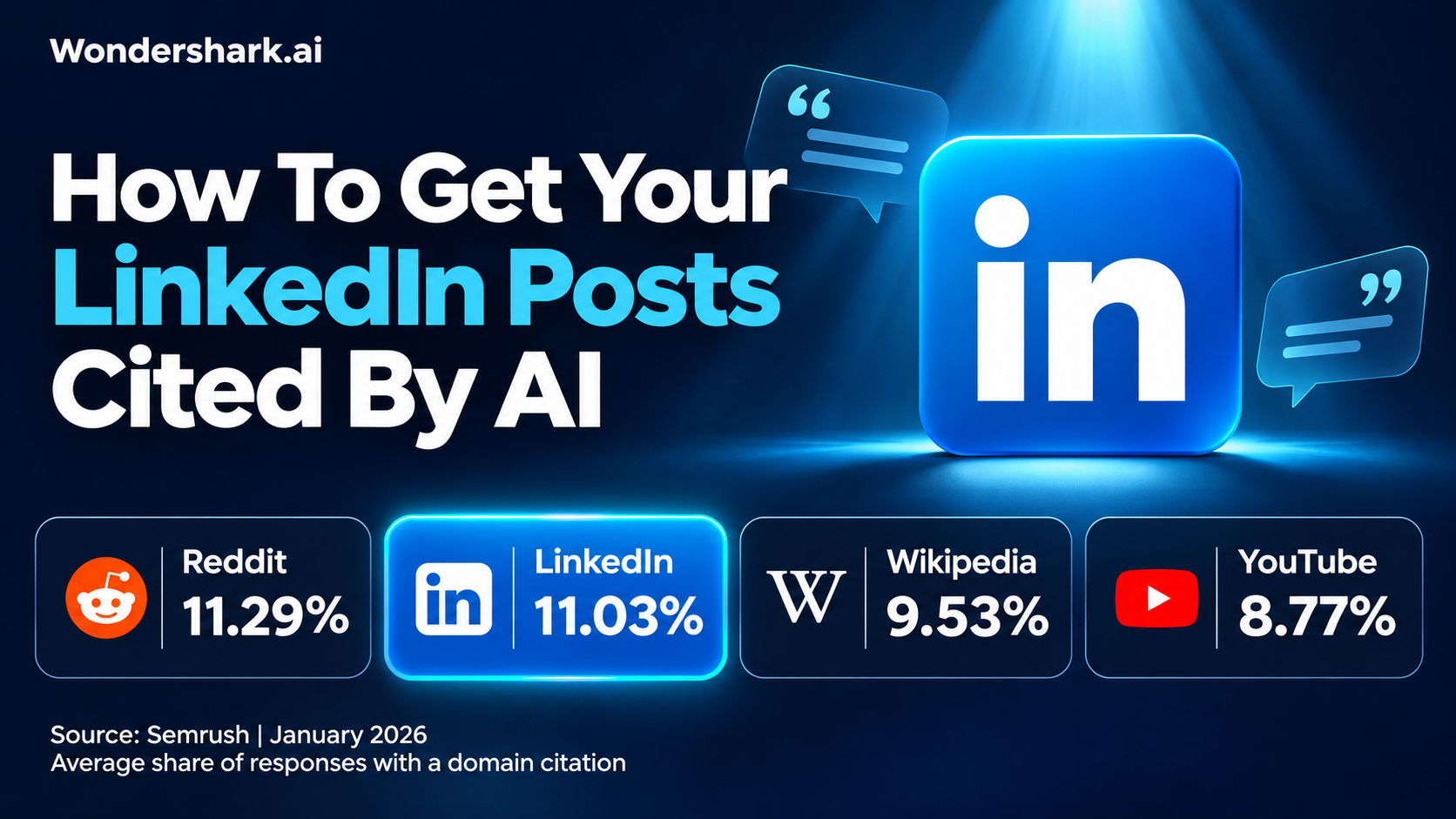
According to Semrush's 2026 study of 325,000 prompts, after Reddit, LinkedIn ranked as the second most-cited domain across ChatGPT Search, Google AI Mode, and Perplexity, appearing in approximately 11% of responses on average.
We'd use this finding as a reason to test LinkedIn for your practice. Whether your posts appear for a particular procedure or city is something you'll need to check.
It also helps to know what you're measuring. A citation means an answer links to your content. A recommendation means the answer suggests your name or practice. An attended consultation means someone has booked and shown up. A surgeon's post might be cited in an explanation of consultation preparation without that surgeon being recommended to a local patient. Track each outcome so you can see where the content is helping.
Start with your profile and your patients' questions
First, check that people outside your network can read what you publish. LinkedIn says posts shared with Anyone can be visible on or off the platform. Article access also depends on yourpublic profile and Articles and Activity settings. Open a published link while signed out to check what a visitor sees. That won't prove an AI tool can retrieve it, but it can reveal an obvious access problem.
Next, make it easy to understand who you are. Review these details on your profile and practice page.
Your name, current role, and accurate professional qualifications.
Your practice name and actual locations.
Your clinical focus and the services you provide.
A link to your physician biography and any relevant publications.
Google's guidance supports clear authorship and reliable sources, particularly for information that affects health. Its E-E-A-T framework covers experience, expertise, authoritativeness, and trustworthiness. Google also says E-E-A-T isn't a specific ranking factor. Think of it as useful guidance for making your expertise clear, rather than a score you can add to a profile.
Once those basics are in place, choose three or four subjects you can discuss well. A plastic surgery practice might cover consultation preparation, treatment decisions, written estimates, and follow-up. A dental practice could focus on implant consultations, treatment alternatives, and questions about proposed fees.
Build the individual posts around questions your team hears. For example, you might answer the following.
What should I bring to my first facelift consultation?
What should I ask when comparing dental implant estimates?
What should I ask a fertility clinic before my first appointment?
Use your location when it adds useful context. A post explaining your Miami practice's consultation process can naturally mention Miami. A general explanation doesn't need the city in every paragraph. We'd rather see a practice answer a small set of relevant questions well than stretch every post to include every service it offers.
Give readers the answer early
The first line should tell people what the post is about. "What should a written facelift estimate explain?" does that immediately. "Something important came up in clinic today" makes the reader wait to find out whether the post will help them.
Then answer the question. You could write, "Ask for a written breakdown of the proposed services, what's included, and what could create an additional charge." The rest of the post can explain those points.
LinkedIn says the first line often helps form the post's URL, and editing the post later doesn't change that original URL. It recommends a clear opening without hashtags at the start. That's another reason to name the subject early, although a keyword in the URL doesn't guarantee a citation.
Keep each paragraph clear enough to make sense on its own. If a statement applies only to your practice or a particular situation, include that detail beside the statement. It should still be accurate if someone quotes just that paragraph.
Here's a sample a practice could adapt after checking its own process.
What should a written facelift estimate explain?
Ask for a written breakdown of the proposed services, what's included, and what could create an additional charge. A total price is easier to understand when you know what it covers.
Start with the proposed procedure. Does the estimate clearly describe what's being considered? Ask the clinic to explain anything that isn't clear.
Then check the included services. Ask how the quote handles the surgeon's fee, anesthesia, facility charges, and follow-up appointments. Confirm each item with the practice instead of assuming it's included.
Ask what happens if the treatment plan changes after further assessment. When would you receive an updated estimate, and how would the clinic explain the difference?
Keep the written information and bring your questions to the consultation. Compare the proposed care and the clinician's qualifications alongside the fees.
Which part of a consultation estimate would you like a clinic to explain more clearly?
Before publishing, add something specific about how your practice handles estimates. Link to your current policy if it'suseful, and have the physician review the wording. That turns a general example into information a prospective patient can use.
Add something your practice can explain firsthand
A well-organized post is a good start. The next question is what the doctor can add that makes it worth reading. LinkedIn's guidance emphasizes firsthand experience and a clear point of view. For a physician, that could mean explaining how you approach a decision or why a common patient question needs a more careful answer.
You could describe a change you made to consultation preparation and why you made it. You could explain what a new study does and doesn't tell patients. Or you could walk through the questions you ask before discussing treatment options. These topics give readers a better understanding of how you think.
Be clear about where the information comes from. Link to the original study when you're discussing research. Say "at our practice" when you're describing your own process. If you're sharing your interpretation, explain your reasoning. If you use your own numbers, include the sample size, time period, and what was measured.
There's some academic support for adding useful evidence. The KDD 2024 paper GEO: Generative Engine Optimization tested changes such as adding sources, quotations, and statistics. Some methods improved source visibility by up to about 40% in its experiments. That measured prominence within generated answers, including the amount and position of text attributed to a source. It doesn'testablish a 40% gain in LinkedIn citations, traffic, or consultations.
The physician should review clinical statements before anything goes live. Protect patient confidentiality, obtain appropriate consent for patient material, and disclose relevant financial relationships. These practices align with the AMA's social media ethics guidance.
Build the week around one good interview
Start with a 30-minute interview with the doctor. Pick one main patient question and ask follow-up questions until the explanation is clear. Ask what people misunderstand, what needs more context, and what the doctor wishes patients knew before an appointment.
Use that conversation to draft an article and a few shorter posts. LinkedIn suggests the following lengths and publishing rhythm as starting points. It also recommends a short summary and clear headings for articles.
Format | Suggested starting point | What to cover |
|---|---|---|
LinkedIn article | One per week, about 800-1,200 words | A patient question that needs context, sources, and a fuller explanation |
LinkedIn post | Two or three per week, about 200-300 words | One useful point, answer, or observation from that topic |
For example, an article about the first consultation could lead to separate posts about records to bring, questions to prepare, and how your practice explains the next steps. Give each post a complete takeaway so it still helps someone who hasn't read the article.
An AI tool can help organize the transcript or draft a version, but check every number, source, and quotation. Have the doctor review the clinical meaning. A practice manager can check appointment details, locations, and administrative information. If you turn the interview into video too, add a clear text introduction and an accurate summary or transcript where practical.
Choose a pace your team can maintain. If weekly articles leave too little time for review, publish fewer. We'd protect the quality of the explanation before increasing the volume.
Keep testing the mix. A smaller GEOforge study covering 292,958 answers across 26 brands found that LinkedIn posts overtook articles in Google's AI answers from late August through early October 2026. That isn't a healthcare benchmark, but it shows why we wouldn't build the whole plan around one format staying ahead forever.
The doctor's profile and the practice page can each contribute. The doctor can explain their reasoning, while the practice page covers useful details about appointments or services. LinkedIn recommends coordinating these voices around shared subjects. Give each person something real to contribute instead of having everyone repeat the same post.
Keep your website connected
A LinkedIn post should give readers a useful next step when they want more detail. That might be your physician biography, a procedure page, or a fuller explanation on your website. Choose the link that helps with the question being discussed.
Keep your important educational content on your website as well. It's a place where your team can update the sources, author details, and practice information directly. Review older material when something changes. Google advises against changing dates simply to make unchanged content look fresh.
Ask your website manager to check that the important pages are accessible and eligible for search. Google says pages need to be indexed and eligible to appear with a snippet to be considered for its generative search features. It doesn't require special AI markup or a particular page length. Its Search Console inclusion control should also allow the site to appear in those features. Inclusion is the default.
For ChatGPT search, OpenAI documents OAI-SearchBot separately from GPTBot, which concerns potential model training. Those controls are independent. Your team can manage access to your website, though LinkedIn controls access to its own platform.
You don't need to handle these technical settings yourself. Have the person responsible for the website check them so an access issue doesn't undermine the publishing work.
Check what AI tools actually cite
Likes and comments give you feedback from readers. To find out whether a post appears in AI answers, you need to check the answers themselves. Semrush found that the median cited post in its sample had no more than one comment, so there's no basis for treating ten comments as a requirement.
Start with 20-30 questions tied to your procedures and real markets. This is our suggested pilot size, not an industry standard. Include educational questions, local searches, and questions about the doctor. "What should I ask at a facelift consultation?" tests something different from "Which facelift surgeons should I consider in [City]?" A question naming your doctor tests whether the answer describes them accurately.
Keep those groups separate. Otherwise, strong results for questions that already contain your name can hide weak results for people who haven't found you yet.
Repeat the same questions using the same settings where possible. Save the prompt, platform, date, search mode, relevant location, answer, and cited links. Begin with a weekly review and use a report like this.
Measure | What to record |
|---|---|
LinkedIn citations | How often an answer links to one of your specific posts or articles |
Physician mentions | How often the answer names the doctor or practice |
Recommendations | How often a discovery answer explicitly suggests the doctor or practice |
Competitor comparisons | How often you and a defined group of competitors appear, using the same counting method |
Accuracy | Whether credentials, locations, procedures, and important qualifications are correct |
Patient outcomes | Identifiable referrals, inquiries, bookings, and qualified attended consultations |
Define the numbers before comparing them. If 12 of 100 valid test answers cite your LinkedIn content, your observed citation rate is 12% for that test set. It says nothing about the percentage of patients who saw you. Count an answer once for that rate, even if it links to several of your posts, and record the individual links separately.
Avoid judging the work from one screenshot. Ahrefs tracked about 37,500 initial citations across five AI tools for 20 days and found substantial turnover. Many citations disappeared and later returned. Look for a pattern across repeated checks before deciding that a content change worked.
For your website, Google Search Console's Generative AI performance report shows impressions from AI Overviews and AI Mode. It won't show citations to your LinkedIn URLs or tell you whether someone booked. The report may also stay unavailable until the site receives enough impressions in those features.
Bring the visibility report together with website analytics and your intake process. Ask new patients how they found you and whether an AI tool helped. Allow them to name more than one influence. Separate referrals you can track from what patients tell you and what your team estimates.
Give the plan 90 days
Use the first 90 days to learn which topics and formats deserve more attention. It's a useful review window, not a deadline by which an AI platform must cite you.
During the first two weeks, check profile access, credentials, website basics, and the subjects you want to cover. Record baseline answers for your question set and do the first physician interview. Decide who checks medical accuracy and who reviews the results.
Over the next month, publish at the agreed pace and record each post's topic, link, and publication date. Respond to appropriate questions and note anything that deserves a fuller explanation. Keep running the same visibility checks.
By the end of 90 days, review which pages and posts were cited, how the doctor was described, and whether inquiries or attended consultations changed. Consider other marketing activity during the same period before crediting LinkedIn for the result.
Then make a specific decision. Expand a topic that produces useful visibility. Fix an explanation that keeps being misunderstood. Improve a website page that leaves an important question unanswered. Keep your original baseline so you can judge whether the next round of changes helps.
Put the doctor's knowledge to work
Wondershark.ai's Discover, Optimize, and Grow approach helps practices assess their AI visibility, compare relevant competitors, and identify gaps in how their expertise is represented. LinkedIn can play a part alongside your website and other credible sources. The business goal is to understand whether that visibility helps the right patients find you and contributes to qualified attended consultations.
Want to see how AI currently presents your practice? Visit Wondershark.ai to book an AI visibility review.
FAQ
Can AI tools cite a doctor's LinkedIn posts?
Yes. AI search tools already cite LinkedIn content in their answers. That doesn't mean every post gets picked up. Check whether your own content appears for questions about your procedures and location, and whether the answer represents the doctor's explanation accurately.
Does my LinkedIn content need to be public?
Use a public audience for content you want people outside your network to find. LinkedIn says posts shared with Anyone can appear on or off the platform. Articles also depend on your public profile and article visibility settings. Opening the link while signed out is a useful first check, though public access doesn't guarantee AI retrieval.
How long should the content be, and how often should we publish?
LinkedIn suggests 200-300 words for posts and 800-1,200 words for articles, with two or three posts and one article each week. Treat that as a starting plan. Publish less if you need more time for a useful explanation and proper medical review.
Do I need lots of comments to earn an AI citation?
There's no established minimum comment count. In Semrush's sample, the median cited post had no more than one comment. Thoughtful discussion can help you understand readers' questions. To measure AI visibility, check which posts are actually cited.
Can AI help write the content?
Yes. Use it to organize an interview transcript or prepare a draft. Check every source, number, and quotation, and have the doctor review the clinical meaning. Follow the AMA's guidance on patient confidentiality and relevant disclosures when preparing material for publication.
How long should we give the plan?
We suggest a 90-day review window, with baseline results recorded before publishing. That's a planning choice, not a promise about when a citation will appear. Use the review to decide which topics deserve more work, which explanations need fixing, and whether the publishing pace is sustainable.
How can I tell whether AI is citing my content?
Repeat a consistent set of relevant questions and inspect the cited links. Record the exact LinkedIn URLs, date, platform, and search settings. Citations can disappear and return, so compare repeated checks instead of relying on one screenshot. Also check whether the answer describes the practice accurately.
Does an AI citation mean more patients?
A citation shows that an answer links to your content. It doesn't establish that the answer recommended your practice or led to a booking. Compare visibility with inquiries and attended consultations, and ask new patients whether an AI tool helped them find you. Account for other marketing activity during the same period.